SAVING
Saving for your financial goals could be easier than you think. You just need to know what you’re working with, and have a plan.
Supercharge your savings
If you’re serious about saving, this short video will explain how easy it can be to develop good savings habits.
Your money will be easier to track and manage if you split it up between different bank accounts. For example, you could open two transaction accounts; one for bills and living expenses and one for spending money, and two high-interest saving accounts; one for emergency funds and one for savings towards your goals.
Independent comparison websites will give you an idea of what interest rates are on offer. Check more than one as most websites don’t cover the whole market. Ask lots of questions about the account to make sure it fits with your saving plans. For example, a bonus rate of interest might only be paid if you deposit a minimum amount each month.
You can automate a split between accounts directly from your pay.
Everyone is different, but saving 10% of your take home pay as a bare minimum is a good start if you are working on developing a savings habit. If you’re single and living on base, why not challenge yourself to save 50% and hit some goals early? Better still; challenge your mates to see who has the better savings willpower.
Establishing a saving habit isn’t hard, you just need to make a start.
Savings plan
- Make sure your budget is accurate so you know how much is available for savings.
- List your financial goals, for example paying off a debt, going on holiday or buying a home. Estimate how much each goal will cost and how long it will take you to save that amount.
- Allocate an amount to each goal from available savings.
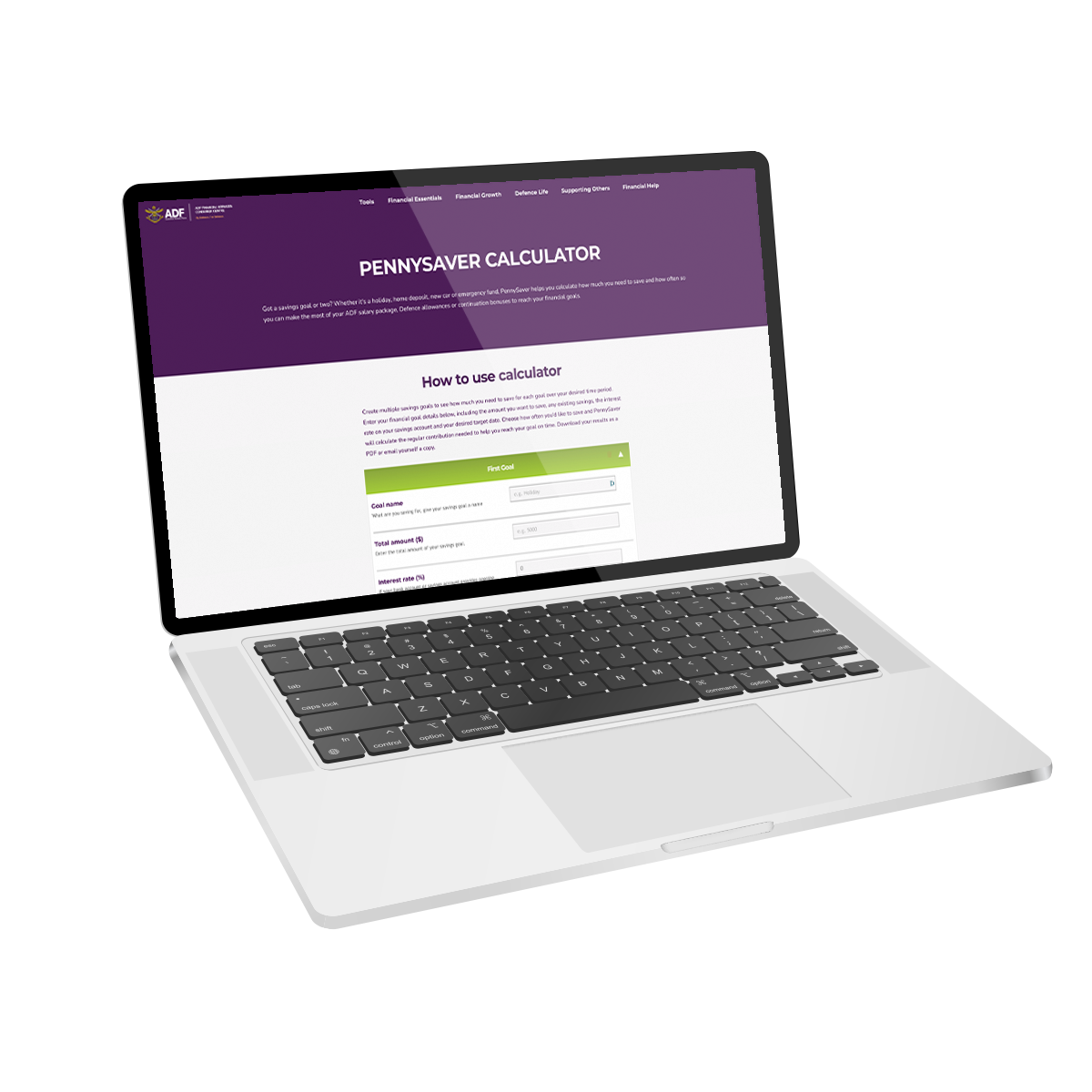
The following table is an example of what your savings plan might look like.
| Goal | Amount | Timeframe | Fortnightly savings |
|---|---|---|---|
| Emergency fund | $5,000 | 1 year | $191 |
| Replace car | $20,000 | 5 years | $150 |
| Property deposit* | $120,000 | 7 years, 11 months | $458 |
| Available to save | $800 | ||
* To be reassessed once car goal achieved.
Calculate how much to save
Use separate accounts for spending and savings
Managing your money will be easier if you use separate bank accounts for bills, personal spending and savings.
You can choose to have your pay automatically split into each account, we suggest setting your savings account as your default account. That way, any extra pay you receive such as allowances or a pay rise, these will be automatically deposited into your savings account, not your spending account.
Bills

Spending
Savings
Choosing accounts
A comparison website can help you find suitable accounts for everyday transactions and savings. Look for accounts that have the features you want, like the ability to set up direct debits and credits, without charging account fees.
Some savings accounts will have conditions attached to them, for example, to earn bonus interest you need to deposit a certain amount each month and not make any withdrawals. Make sure you can satisfy the conditions before opening the account.
Don’t be afraid to move your money around if higher interest rates are only offered for an introductory period. Opening a new account and transferring money to yourself is a pretty simple process with most financial institutions.
If you have a partner, consider whether you want joint accounts or whether you are keeping your finances separate for now.
Government guarantee on deposits
Sometimes people hesitate to take advantage of better interest rates or accounts with better features because the accounts are with financial institutions they are not familiar with. Most banks, building societies, credit unions, and online financial institutions are authorised deposit-taking institutions (ADIs)
Under the Financial Claims Scheme (FCS), the Australian Government guarantees deposits held by individuals with an ADI in Australia, up to $250,000 per person, per ADI, in the unlikely event that one of these institutions fails.
You can find a list of ADIs on the Australian Prudential Regulatory Authority (APRA) website.
Money saving ideas
Financial products
Cutting discretionary spending is not the only way to put some dollars back into your budget. Reviewing financial products, like bank accounts and insurances can save you a lot of money, especially if you haven’t done it for a while.
Transaction accounts
If your bank charges account keeping fees, switch to a financial institution that offers a basic bank account with:
- No account keeping fees
- Free monthly statements
- No minimum deposit amounts
- No overdrawn fees
Savings accounts
Imagine you have $50,000 saved in your bank’s standard savings account, paying interest of 0.2% pa, or about $100 a year in interest. If you moved your money into an online savings account paying 2% pa, you could be earning $1,000 a year in interest, 10 times as much.
Search comparison websites now for a better deal on your savings. It’s a very easy way to boost your budget.
Home loans
Lenders don’t usually tell you if there are cheaper home loans available, and why would they? Would you go to your boss and offer to do the same job for less money?
Most home loan interest rates are negotiable, you just have to ask. Use a comparison website to see how your loan stacks up against other loans with similar features. If you find a better rate, ask your lender to match it. If you’re a good customer, chances are they’ll be willing to negotiate. If not, consider switching home loans.
This will require a bit of effort on your part, but could save you thousands of dollars a year. Another lender may even be willing to offer an upfront cashback to help with switching costs, or be willing to waive establishment fees, you won’t know if you don’t ask.
Personal loans
As personal loans are usually fairly short-term, in comparison to a home loan, it is often not cost effective to switch personal loans.
Find out whether you can repay the loan early without penalty. If you can, your best bet may be to look for savings elsewhere in your budget and use them to pay down personal loans faster. The same goes for any other high-interest credit you may have.
Credit cards
If your credit card has a high interest rate and you don’t pay the balance off at the end of each month, consider switching to a lower rate credit card. A comparison website will identify cheaper options and also alert you to any balance transfer deals. For example, many credit card providers will offer you a very low – or even 0% – interest rate for a set period of time, to switch to them.
Unless you genuinely believe you can pay the card off within the interest-free, or low interest period, only consider switching to a card that has an ongoing interest rate that’s the same or lower than what you currently have. A card that defaults to a higher interest rate after the introductory period could end up costing you more in the long run.
A word of warning: switching cards too often can affect your credit rating.
Insurance policies
When you receive an insurance renewal notice, we suggest you do the following before you pay it:
- Pretend to be a new customer – go to your insurer’s website and get a quote as if you were a new customer, more often than not the quote will be cheaper than your renewal notice
- Compare other insurers – use a comparison website to compare the cost for similar cover with other insurers
- Contact your insurer – ask them to match a cheaper quote. If they don’t price match for existing customers, they may be prepared to treat you as a new customer if you choose not to renew your current policy. Sounds ridiculous, but it usually works
Consider switching insurers if necessary. You might be surprised at how easily this can save you money.
Surf the net
The internet is full of websites, blogs and social media groups dedicated to saving money on all sorts of things, for example Money Smart. Use some spare time searching for savings tips and tricks you can use to keep a few more dollars in your pocket.