Income Tax
Declaring your income, making suitable claims and lodging your tax returns on time. This guide and the ADF member specific information on the ATO website can support you in completing your tax returns each year.
In Australia, individuals pay tax on a Pay As You Go system, which means you pay income tax on your money as you earn it. Defence deducts an appropriate amount of tax from your pay each fortnight.
The Australian taxation system uses a sliding tax scale, so the more you earn, the higher the percentage of tax you pay. The highest rate of tax you pay is known as your marginal tax rate.
For the most up to date information about income tax rates, visit the ATO website.
Income and deductions
Do you know what income ADF members must declare or what expenses are allowed as deductions? This short video tells you what you need to know to get your tax right.
In Australia, income tax is levied on a progressive scale, which means the more you earn, the higher your top rate of tax. This is called your marginal tax rate. You can find out more about individual income tax rates on the Australian Tax Office website.
Tax time can seem like a bit of a chore, but it doesn’t have to be if you’re organised.
You can complete your own tax return via the myGov portal. You must lodge your return by October 31 each year. If you are using a registered tax agent or accountant you will have longer to lodge your return.
By August, most of your income details such as salary and wages, interest and investment income, will be pre-filled on your online form, so all you’ll need to do is check that the details are correct, add your deductions and submit the form.
Most income you earn has to be declared. This includes your salary and allowances, interest, rental income, dividends and other investment income, including any capital gains or losses. If you’re not sure what income must be included, visit the ATO website and search for income guides.
You do not have to declare income earned for reserve service except for periods of continuous full-time service. Income from some deployments are also tax-exempt. You’ll learn more about this during your Force Preparation Course.
Deductions are certain work or investment-related expenses that reduce your taxable income, which in turn reduces the amount of tax you have to pay. To claim a deduction for a work-related expense, it must directly relate to earning your income, you must have spent the money and must not have been reimbursed, and you must be able to prove it.
The ATO’s tax guide for ADF members also explains what you can and can’t claim. Let’s look at a few examples.
ACW Smith spent $546 on compulsory work uniforms, including stockings, which are required by the Air Force Manual of Dress. She can claim these costs as legitimate deductions as well as the costs of cleaning her uniform.
ACW Smith also pays a gym membership so she can keep fit when at home. Even though, as an ADF member, she is expected to maintain a high standard of physical fitness, this expense is considered personal, and is not deductible.
Corporal Cross on the other hand, is a member of the Special Forces. He is required to maintain a level of fitness well above the regular Army standard. Corporal Cross needs the gym to maintain the peak physical condition his job requires, so his gym membership is deductible.
Some ADF members make deduction claims which are excessive or are not able to be proven. Deductions work on an ‘honour system’ but be warned, if you make fraudulent claims, you will be caught. It’s only a matter of time. These members receive fines, are charged interest and are required to pay the amounts back to the ATO.
For help completing your tax return, find a registered tax agent on the Tax Practitioners’ Board website. Registered tax agents will lodge your return for you.
If your situation is more complex or you want specialist tax advice on areas such as investment properties or shares, you might need an accountant, who should also be a registered tax agent.
To find a qualified accountant in your area, we suggest using the search function available on professional association websites, such as CPA Australia or Chartered Accountants Australia New Zealand.
Being organised will save you time and money, but remember, you are responsible for your tax return, so make sure you include all your income, and that your deductions are legitimate before your tax return is lodged.
A final word of warning. Some tax agents and accountants sell investment products, insurance and real estate, often as their main business, from which they earn commissions and other sales incentives. Therefore, they may not act in your best interests. To learn more about this, watch our video, ‘Financial Advisers: The facts and the fiction’.
Making claims
The Australian Tax Office (ATO) has guides for ADF members that explain what income must be declared and what is allowable as deductions. Work-related deductions could include car or travel expenses, uniform expenses, mess fees, self-education expenses you have paid for, and fitness expenses for certain ADF members. If you’ve worked from home, you may be able to claim phone, internet and other home office expenses. The ATO has information available on their website on what you can claim.
Generally you will need to declare all of your income, other than tax-exempt deployment or reservist income. If you have been on deployment, you will have been notified before you deployed if your deployment income fell into a tax-exempt category.
For deductions to be allowed:
- you must have spent the money yourself and not been reimbursed
- it must directly relate to earning your income
- you must have a record to prove it, or be able to demonstrate how you calculated the claim.
Don’t be tempted to make ‘dodgy’ claims, chances are you’ll be caught and issued with fines and other penalties. The last thing you need is a tax audit.
You can lodge your tax return for free through myGov.
Lodging your tax return
If you are completing your own tax return, using the myGov website, it needs to be lodged by 31 October. If you are using a registered tax agent or accountant, you’ll have until 31 March the following year.
Going on deployment?
Depending on where you are deploying to, and for how long, you may not pay tax on some of your earnings. While paying no tax for a period is generally a positive for you, there may be other factors to consider. Take a look at Preparing for Deployment section for more information.
Accounting & tax advice
For help with a simple tax return, a registered tax agent may be all you need. You can find a registered tax agent in your area by using the search function on the Tax Practitioners Board website.
If your financial affairs are more complex, you may be better off speaking to a qualified accountant that has completed additional professional training. You can find a list of appropriately qualified accountants on the websites of industry associations such as Chartered Accountants of Australia and New Zealand or CPA Australia.
Knowledge Quiz
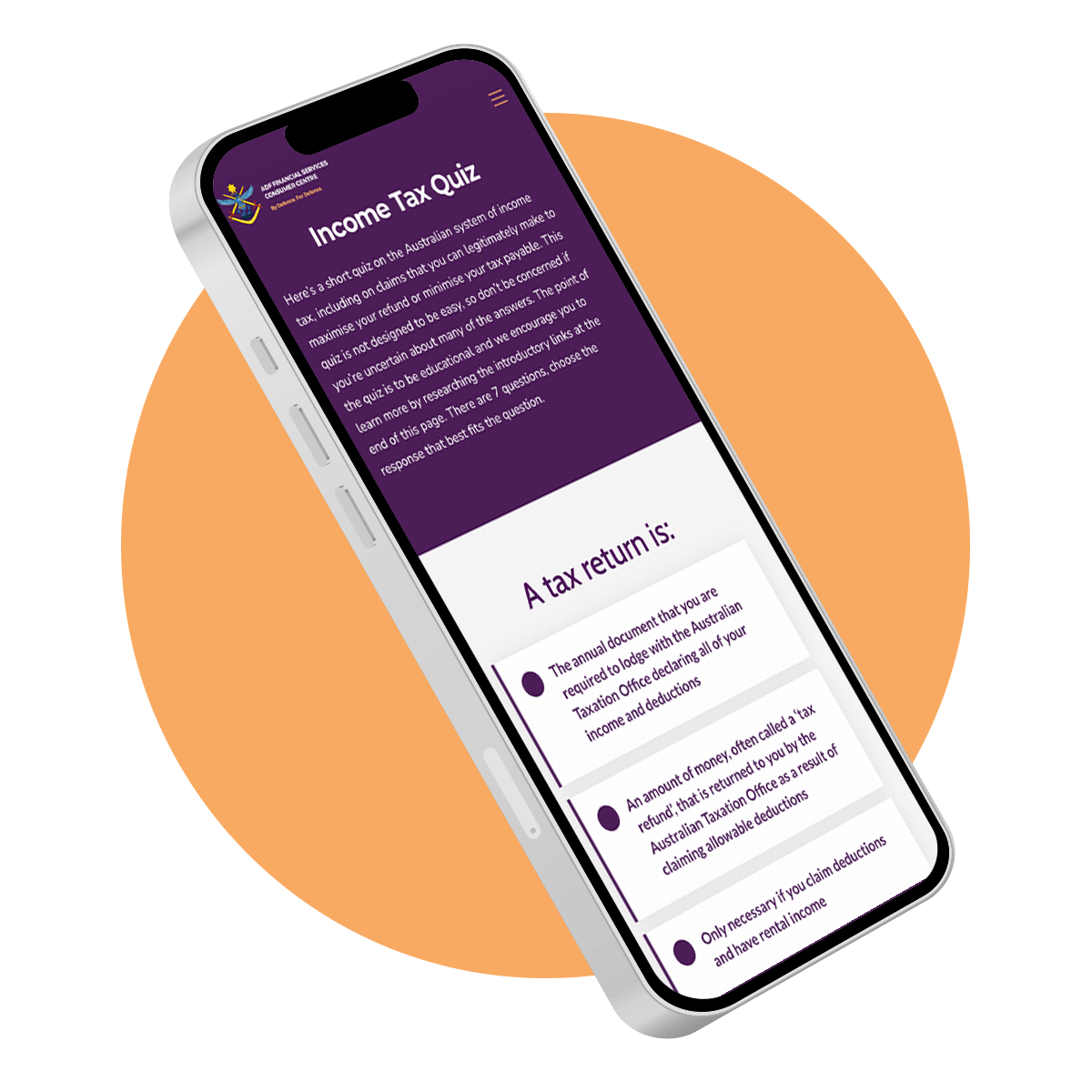
Understanding the Australian system of income tax is not an easy topic. This quiz on Income Tax is designed to be challenging. We provide introductory links and resources you can use for further research to learn more.
Frequently Asked Questions
There are a range of tests to determine residency for tax purposes. They are outlined on the ATO website section. Your tax residency. In addition, there are special rules outlined in PACMAN for the (mostly tax exempt) treatment of income earned whilst on an ADF deployment.